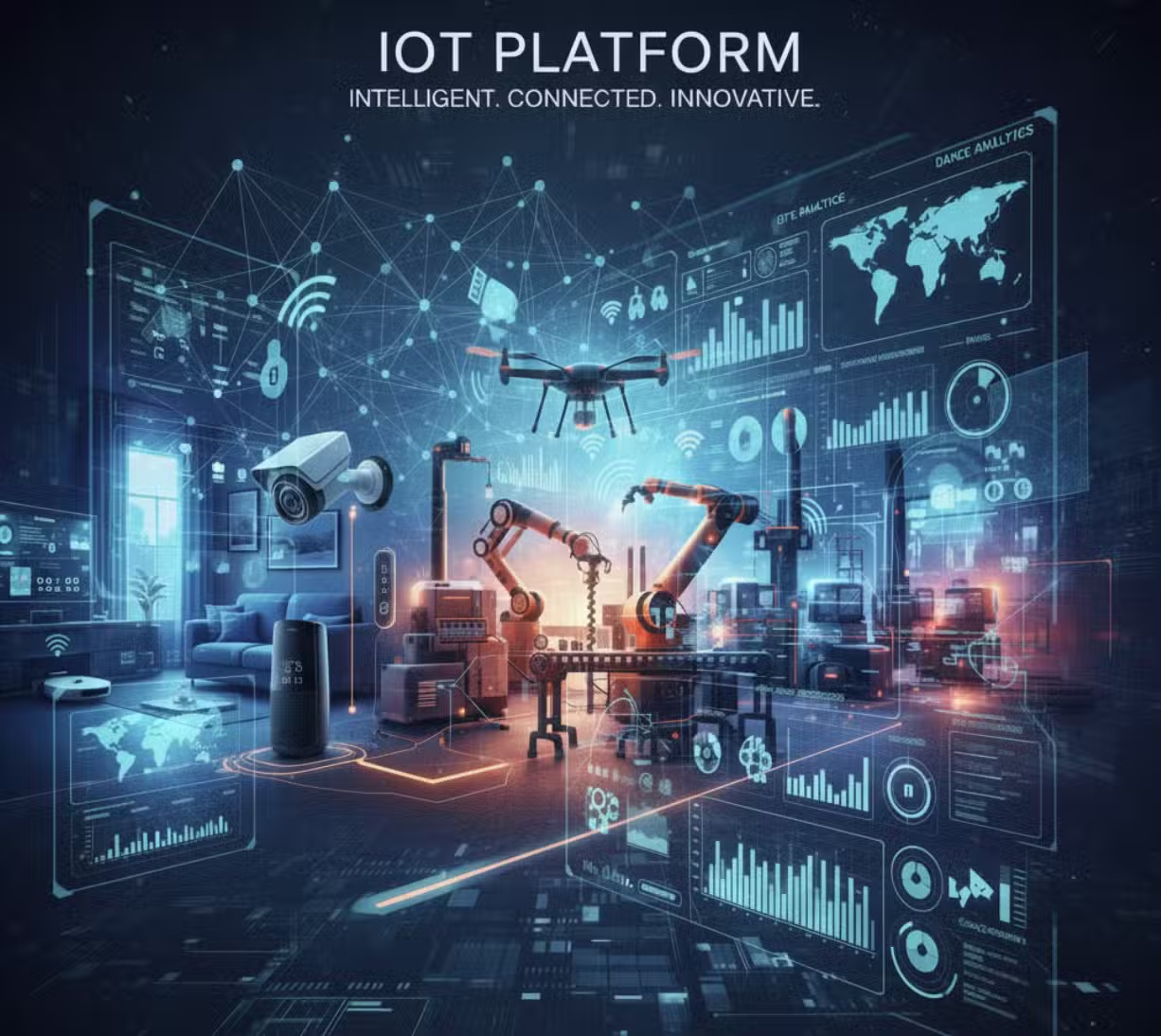
From smart thermostats that learn your habits to factory machines tracking oil pressure, fuel levels, and temperature in real time, the Internet of Things (IoT) has become the backbone of modern connectivity. Yet, the invisible force behind these connected experiences is something few people think about: the IoT Platform.
These platforms act as the central nervous system, collecting data, managing devices, and translating information into meaningful actions. Whether at home adjusting your thermostat or at work monitoring industrial equipment, IoT platforms are everywhere, powering everything from personal convenience to large-scale operational efficiency.
In this article, we’ll explore what IoT platforms are, how they work, and why businesses (from logistics to manufacturing) are relying on them to drive automation, efficiency, and innovation. Drawing from Seisan’s experience developing connected solutions across multiple industries, we’ll help you understand what makes IoT platforms essential to today’s digital transformation.
What Is an IoT Platform?
An IoT platform is the middleware that connects physical devices (sensors, gateways, machines) to the cloud and business applications. It enables secure data flow between hardware and software, enabling automation and analytics.
Much like we use messaging and social media platforms to communicate with others, share updates, and stay informed, IoT platforms provide the same communication layer, but for machines. Devices use these platforms to share status, trigger events, and keep each other and their operators updated, creating an intelligent network of connected systems.
In short, an IoT platform does four main things:
-
- Connects devices: Establishes communication between sensors, machines, and cloud systems.
-
- Manages data: Collects, filters, and stores vast amounts of information.
-
- Analyzes insights: Transforms raw data into dashboards, trends, and actionable intelligence.
-
- Integrates applications: Bridges IoT data with enterprise tools, such as ERP or CRM systems.
-
- Automates actions: Enables devices to respond automatically to specific conditions or triggers—for example, activating cooling when temperature thresholds are exceeded or sending alerts when equipment pressure drops.
Core Functions of an IoT Platform
Device Management
An IoT platform enables administrators to register, monitor, and manage thousands, or even millions, of devices simultaneously. This includes handling firmware updates, diagnosing issues, and ensuring devices remain secure and connected.
Connectivity
Connectivity ensures that devices communicate consistently and securely through various protocols (MQTT, HTTP, CoAP). Platforms must adapt to network types, from Wi-Fi to 5G, and ensure data flows efficiently even in constrained environments.
Data Collection & Storage
IoT platforms handle massive data volumes, capturing sensor readings, GPS locations, or machine metrics. They provide secure, scalable storage (on-premises or in the cloud) to support real-time access and long-term analytics.
Analytics & Insights
The true power of IoT lies in analytics. Platforms use AI and machine learning to process data, identify patterns, and generate predictive insights, for example, predicting equipment failures before they occur.
These platforms also provide human-readable dashboards that present device performance, automation activity, and operational insights in an accessible way. Users can easily adjust rules, thresholds, and triggers, empowering them to fine-tune how devices respond to changing conditions.
Integration with Applications
Modern IoT platforms seamlessly integrate with enterprise systems such as ERP, CRM, and analytics dashboards. This enables data-driven decision-making and business process automation.
Many also provide mobile interfaces for users on the go, along with notification systems that send emails or text alerts when certain conditions occur, ensuring humans can intervene or review updates that require their attention.
Security & Compliance
Security is at the heart of every IoT deployment. Platforms ensure encryption, authentication, and compliance with industry standards such as ISO 27001 and GDPR. From the backend platform to the devices to mobile or web applications, a comprehensive security strategy must be in place to lock down the system and protect it from bad actors.
Types of IoT Platforms
Device Management Platforms
Focus on lifecycle management, onboarding, monitoring, and remote device maintenance.
-
- Azure IoT Hub / Device Provisioning Service — Secure bidirectional communication, device registry, and automated provisioning for Azure IoT ecosystems.
-
- Google Cloud IoT Core (Legacy / now retired) — Provided secure device connectivity and management; many organizations transitioned to alternatives like Particle or EMQX.
-
- ThingsBoard — Open-source and enterprise-ready IoT platform with device provisioning, telemetry dashboards, and rule-based automation.
-
- Bosch IoT Suite (Device Management) — Offers remote management, firmware updates, and digital twins for industrial-scale IoT.
-
- Oracle IoT Cloud Service — Provides digital twin modeling, device management, and data analytics under Oracle’s enterprise cloud.
-
- Davra IoT Platform — Combines device lifecycle management, analytics, and app enablement—strong in industrial and smart city use cases.
-
- Particle — Full-stack IoT platform with device provisioning, remote firmware management, and cellular connectivity built in.
-
- Balena Cloud — Container-based device management for edge Linux devices (great for Raspberry Pi and embedded systems).
Connectivity Platforms
Specialize in data transmission between devices and cloud systems, managing network protocols, bandwidth optimization, and data routing.
-
- EMnify — Global cellular IoT connectivity platform with network and SIM management via APIs.
-
- Hologram.io — Simplified global IoT SIM management and cellular data provisioning.
-
- Soracom — IoT connectivity-as-a-service platform offering SIM management, bandwidth optimization, and edge data routing.
-
- Sierra Wireless Octave — Provides connectivity orchestration, data routing, and device cloud integration for industrial IoT.
-
- KORE Wireless — Enterprise-grade managed IoT connectivity services, including eSIM and global carrier support.
-
- 1NCE — Offers low-cost lifetime IoT connectivity plans with simple pricing and API management.
Application Enablement Platforms (AEPs)
Provide tools and APIs for developers to build and deploy IoT applications faster.
-
- ThingWorx (PTC) — Rapid IoT application development with model-driven design, analytics, and AR integration.
-
- Siemens MindSphere — Cloud-based industrial IoT platform with APIs, app store, and integration tools.
-
- AWS IoT Core & AWS IoT SiteWise — Scalable IoT building blocks for developers, including APIs, rules engines, and analytics tools.
-
- Azure IoT Central — A ready-to-use SaaS solution for IoT application development with minimal coding.
-
- Oracle IoT Cloud Applications — Offers templates and tools to quickly develop IoT-driven enterprise apps.
-
- Losant — Low-code IoT AEP with workflow automation, dashboards, and enterprise deployment options.
-
- OpenRemote — Open-source AEP for integrators to build custom IoT dashboards, logic, and automation.
-
- Davra — Provides combined AEP, analytics, and device management capabilities for industrial IoT.
Analytics Platforms
Offer deep insights and visualization tools, using machine learning to reveal trends and improve decision-making.
-
- AWS IoT Analytics / AWS IoT Events / SageMaker — End-to-end IoT data ingestion, transformation, and AI-driven analytics.
-
- Azure IoT + Azure Stream Analytics / Time Series Insights — Real-time and historical IoT data visualization and pattern detection.
-
- GE Predix — Purpose-built for industrial analytics and asset performance management.
-
- Siemens MindSphere (Analytics Layer) — Combines visualization, data lake integration, and predictive capabilities.
- Splunk for IoT — Machine data analytics, anomaly detection, and dashboarding for IoT environments.
Benefits of Using an IoT Platform
Challenges and Considerations
Deploying IoT platforms comes with challenges: interoperability between devices, data privacy, and maintaining consistent connectivity. Organizations must balance scalability, security, and cost. Based on the deployment’s physical requirements, factors such as connectivity type, battery power, and device and IoT platform timing often pose major challenges.
Understanding how to properly architect these solutions (from network selection to data transmission intervals) is critical for long-term reliability and performance. Selecting the right platform often depends on use case, compliance requirements, and integration capabilities.
Partnering with experienced development teams, such as Seisan, ensures the architecture and implementation align with business goals.
Real-World Applications of IoT Platforms
AWS IoT Core
Massive scalability, wide device support, and seamless integration with AWS services. Ideal for smart homes, logistics tracking, and connected vehicles.
Microsoft Azure IoT Hub
Known for its enterprise-grade security and hybrid edge/cloud support. Excellent for industrial IoT and predictive maintenance.
Google Cloud IoT
Offers AI-driven analytics and robust data processing for industries that need deep insights, such as healthcare and retail.
Siemens MindSphere
Tailored for Industry 4.0, this platform supports manufacturing, energy, and equipment monitoring with deep connectivity.
IBM Watson IoT
Combines cognitive analytics and AI-powered insights to optimize supply chains and predictive maintenance.
Samsung SmartThings
Focused on home automation and consumer IoT, SmartThings provides an easy-to-use platform for connecting appliances, sensors, and lighting systems through a single unified app. It’s compatible with a growing range of third-party devices and integrates seamlessly with voice assistants like Alexa and Google Assistant.
Emerging Cross-Platform Standards: Matter
Matter is an open standard developed by major technology companies to unify smart home ecosystems – CSA (Matter). It enables interoperability between devices from different brands, ensuring that smart bulbs, locks, and thermostats can communicate reliably regardless of manufacturer. This growing standard represents the next evolution of consumer IoT, simplifying integration for both developers and end users.
Future of IoT Platforms
The future of IoT platforms is driven by edge computing, AI integration, and sustainability initiatives. Platforms will increasingly process data closer to where it’s generated, enabling real-time insights and reduced cloud dependency.
Today, many IoT platforms and device ecosystems do not always communicate directly with one another. However, evolving cross-platform standards are helping bridge this gap, allowing various device brands and ecosystems to operate seamlessly together.
Expect tighter security standards and new interoperability frameworks to enable seamless device connectivity across industries.
Conclusion
IoT platforms are the foundation of modern connectivity. They bridge the physical and digital worlds, providing the tools businesses need to automate, scale, and innovate. Whether it’s optimizing manufacturing lines or creating smarter cities, these platforms turn data into intelligence.
At Seisan, our aim is to work with you regardless of the IoT platform to tackle your business objective. For over 20+ years, we have been helping companies innovate, create, and build complex IoT integrations. If you are interested in meeting one-on-one to discuss your needs, feel free to contact us.