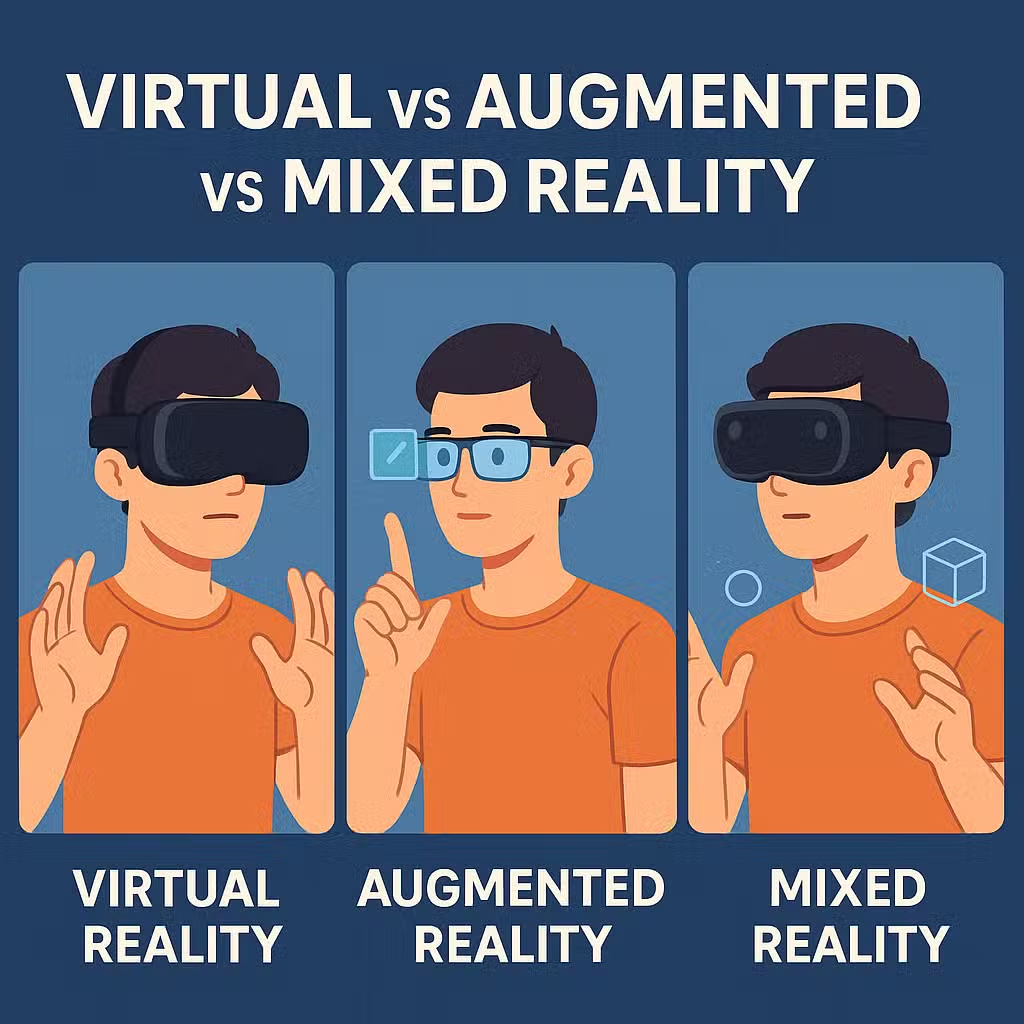
Over the years, the immersive technology industry has rapidly evolved. It began with Virtual Reality headsets like the early Oculus Quest, which transported users into fully digital worlds.
Next came mobile-based Augmented Reality, with experiences such as Nineteen Crimes wine labels and Ikea’s furniture app, where pointing a phone at a room suddenly revealed digital content layered over the real world. Most recently, the emergence of Mixed Reality glasses and headsets has shown what happens when physical and digital truly interact, creating experiences far beyond a simple overlay.
For businesses, understanding these differences isn’t just tech trivia; it’s a way to uncover new tools for training, storytelling, and engagement. From entertainment to healthcare, these immersive realities are already reshaping how companies connect with customers, employees, and data.
In this post, we’ll break down VR, AR, and MR in simple terms, walk through their applications, and show where they shine (and fall short). Along the way, I’ll share insights from Seisan’s own work building immersive and interactive solutions, helping organizations bring futuristic ideas into real-world operations.
What is Virtual Reality (VR)?
Virtual Reality transports you into a fully digital environment. Slip on a VR headset, and suddenly you’re in a place that doesn’t exist, an alien planet, a reconstructed historical site, or a safety training simulation.
Key traits of VR:
– Immersion: Blocks out the real world entirely to capture your focus and attention on tasks.
– Interaction: Uses controllers, gloves, or sensors to interact with the digital space.
– Hardware: VR headsets (e.g., Meta Quest, HTC Vive, PlayStation VR).
Examples: At Seisan, we’ve developed a range of VR solutions. One project provided fully immersive safety training where workers could practice scenarios such as operating heavy machinery in a risk-free environment, building confidence, and reducing accidents.
Another project was a full factory tour experience, where users interacted with different station machines for an interactive “how it’s made” walkthrough. We also created a 360° VR program that placed social workers in challenging scenarios, guiding them with questions and tips for handling sensitive situations effectively.
What is Augmented Reality (AR)?
Augmented Reality layers digital content onto the real world. Instead of removing you from your environment, AR extends your world (whether at home, in the office, or on the go) with layers of digital engagement and information.
Today, AR goes well beyond simple overlays. It is used to enhance indoor and outdoor environments with Visual Positioning Systems (VPS).
VPS technology uses real-world mapping and location data to anchor digital content to precise locations, allowing AR experiences to be overlaid on buildings, monuments, or even entire city blocks. This means digital information doesn’t just float in space, but is contextually tied to the physical world around you.
Key traits of AR:
– Overlay: Real-world view remains, with digital elements placed on top.
– Devices: Smartphones, tablets, or AR glasses.
– Interaction: Often touch-based (on screen), sometimes gesture or voice.
Examples:
At Seisan, we’ve created AR-driven experiences that go well beyond retail. We’ve built AR-based routing and tours that let users engage with real-world items, triggering video and image pop-ups that explain more about the environment.
We’ve designed walking path overlays that guide people along specific tours or routes, blending digital directions with the physical world. And we’ve added gamification features that let users collect points or earn scores based on the depth of their exploration, making learning and navigation both fun and informative.
Retailers also use AR to let shoppers “try before they buy.” Want to see how a sofa fits in your living room? Point your phone at the 3D model, and you’ll know instantly.
What is Mixed Reality (MR)?
Mixed Reality sits between VR and AR, blending both worlds so digital and physical elements can interact in real time. Unlike AR’s static overlays, MR makes holograms that understand and respond to the physical space.
Key traits of MR:
– Integration: Real-world and digital objects coexist and interact.
– Devices: Advanced headsets (Microsoft HoloLens, Magic Leap).
– Interaction: Gesture, gaze, and voice-based inputs.
Examples: Healthcare training often uses MR. Imagine a surgeon seeing a holographic heart hovering above a real patient model, rotating it, zooming in, and simulating procedures. At
Seisan, we’ve seen how MR can bridge training gaps in industries where practice has real-world risks or requires expensive, depletable materials. We’ve also designed MR applications that support training scenarios in engineering and manufacturing, where interacting with holographic prototypes reduces costs and accelerates learning.
Business & Industry Applications
Healthcare
Immersive technologies are transforming healthcare from training to patient care. VR enables surgeons to rehearse complex procedures in virtual simulations, while AR provides real-time overlays during surgery, such as highlighting arteries or displaying vital statistics on smart glasses.
MR takes it further, enabling doctors to visualize 3D anatomy in real patients, improving both diagnostics and surgical precision. At Seisan, we’ve seen how these tools can reduce error rates and improve confidence in high-stakes environments.
Education & Training
In education, VR classrooms transport students anywhere, from ancient Rome to outer space, turning abstract lessons into lived experiences. AR enhances textbooks with interactive 3D models, while MR creates collaborative lab environments where physical and digital materials merge. Businesses use these same technologies for safety and skill training, replacing costly physical setups with reusable digital simulations.
Retail & ECommerce
Retailers use AR for virtual try-ons and in-store navigation, while VR delivers immersive product experiences and store previews. MR is starting to appear in showrooms, enabling customers to interact with digital products in physical spaces. Seisan has implemented AR-based experiences that allow customers to explore real-world products enhanced with digital storytelling, bridging engagement and conversion.
Manufacturing
VR training environments prepare workers for equipment operation and safety protocols, while AR overlays provide step-by-step digital guides to help technicians perform maintenance. MR allows engineers to manipulate holographic prototypes alongside real components, enabling rapid testing and collaboration.
Entertainment & Gaming
Immersive technology continues to reshape entertainment. VR delivers fully interactive gaming worlds and cinematic storytelling, AR extends experiences into players’ physical spaces, and MR merges both, letting users physically move and interact within dynamic mixed environments.
From live concerts enhanced by holographic visuals to location-based AR games, entertainment remains one of the most dynamic testing grounds for immersive innovation.
The Future of Immersive Technologies
As immersive technology continues to evolve, we’re entering an era where digital and physical experiences will blend more naturally than ever before. Spatially aware solutions are creating advanced engagement opportunities, environments that recognize where you are, what you’re looking at, and how you’re moving.
These systems can adapt in real time, whether it’s overlaying virtual data on a real machine or guiding someone through a museum using spatial anchors.
The future also points toward lightweight, wearable AR glasses that could fundamentally change how we interact with the world around us. Imagine walking through your day (checking messages, receiving directions, or accessing digital tools) all seamlessly overlaid on your field of view.
As these glasses become smaller and more powerful, they may even eliminate the need for traditional phone screens, merging our digital and physical lives in ways once imagined only in science fiction. Immersive technology’s future is not about escape; it’s about integration.
Ready to Explore Immersive Technology for Your Business?
Whether you’re looking to enhance training programs with VR simulations, create engaging AR experiences for customers, or develop cutting-edge MR applications, the right immersive solution can transform how your organization operates and connects with its audience.
At Seisan, we’ve helped businesses across industries bring their immersive visions to life. From safety training simulations to interactive AR tours and mixed reality prototyping, we understand how to match the right technology to your specific goals.
Let’s discuss which immersive reality makes sense for your needs. Contact our team today to explore how VR, AR, or MR can create meaningful impact for your organization.
The future of engagement is immersive, let’s build it together.