
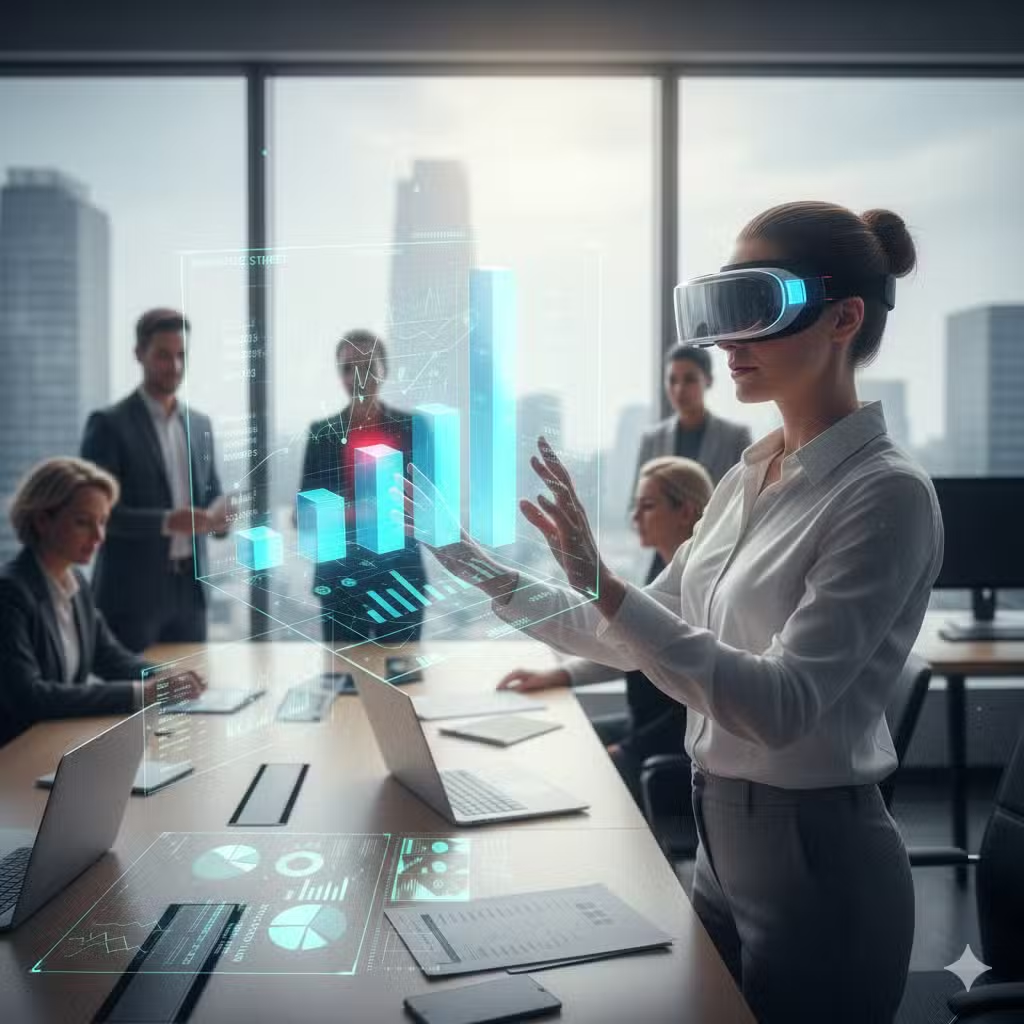
AR Transforms the Numbers Game
Accounting has always been about making sense of numbers, but traditional tools, such as spreadsheets and flat reports, have significant limitations. Accountants spend countless hours parsing through data, searching for patterns, anomalies, and insights that could impact business decisions.
Augmented reality is beginning to change this fundamental approach. By overlaying digital information onto physical documents and creating interactive 3D visualizations of financial data, AR enables accountants to view their data in new dimensions.
While AR adoption in accounting is still emerging, forward-thinking firms are already experimenting with applications that streamline workflows and enhance client services. The technology isn’t replacing accountants; it’s amplifying their capabilities and making complex financial information more accessible and understandable.
The potential market for AR in professional services is substantial, with early adopters gaining competitive advantages through enhanced efficiency and more compelling client presentations.
AR Applications in Daily Accounting Work
Real-time data visualization transforms how accountants interact with financial information. Instead of scrolling through endless spreadsheet rows, AR can display financial trends as interactive 3D graphs that float in your workspace, allowing you to manipulate data with natural gestures and instantly spot patterns.
Document processing becomes significantly more efficient with AR-enhanced scanning. Point your device at an invoice or receipt, and AR systems can automatically extract relevant data, verify it against existing records, and flag discrepancies, all while showing you exactly what information is being captured.
Financial statement analysis gains new depth when accountants can interact with data spatially. Imagine examining a balance sheet where you can literally pull apart line items, see their composition in detail, and trace transactions back to source documents with simple gestures.
Collaborative auditing takes on new dimensions when remote team members can see the same AR overlays on physical documents. An auditor in one location can annotate documents that colleagues across the country view in real-time, significantly streamlining review processes.
Strategic Benefits for Accounting Firms
Enhanced data comprehension is AR’s most valuable contribution to accounting work. Complex financial relationships that are difficult to grasp in traditional formats become immediately apparent when visualized in three dimensions with interactive elements.
Pattern recognition improves dramatically when data is presented spatially. Anomalies that might be buried in spreadsheet rows stand out visually in AR representations, helping accountants identify issues or opportunities more quickly.
Time savings accumulate across numerous minor improvements. When document processing is faster, data verification is visual, and information retrieval is intuitive, accountants can focus more energy on analysis and strategic advice rather than data manipulation.
Client communication benefits enormously from AR-enhanced presentations. Financial projections that feel abstract in traditional formats become tangible and understandable when clients can interact with 3D models of their financial scenarios.
Implementation Considerations
Hardware requirements for AR accounting applications vary based on use case. Many applications work effectively on tablets or smartphones with AR capabilities, while more sophisticated implementations might benefit from dedicated AR glasses for hands-free operation.
Integration with existing accounting software is crucial for the practical adoption of this solution. AR tools must connect seamlessly with platforms like QuickBooks, Xero, or enterprise systems to access real-time data without requiring additional data entry work.
Training needs should not be underestimated, though modern AR interfaces are often quite intuitive. Staff members need time to become comfortable with new interaction paradigms and understand how AR tools fit into their existing workflows.
Data security and compliance remain paramount in accounting applications. Any AR system must meet the same rigorous security standards as traditional accounting tools, with proper encryption, access controls, and audit trails.
The Future of AR in Accounting
Emerging capabilities point toward even more sophisticated AR accounting tools. As the technology matures, we’ll see deeper integration with artificial intelligence that can proactively identify issues and suggest actions based on visual data analysis.
AI-enhanced AR systems will be able to automatically flag unusual patterns, predict cash flow issues, and provide contextualized recommendations, all presented through intuitive visual interfaces that make complex analysis accessible to both accountants and clients.
The convergence of AR with blockchain technology could create fascinating new approaches to audit trails and transaction verification, where the entire history of a financial transaction becomes visually traceable through AR interfaces.
At Seisan, we’re exploring how AR can transform professional services, including accounting. Our approach focuses on creating practical applications that integrate smoothly with existing workflows rather than requiring complete process overhauls.
We understand that accounting firms require solutions that enhance, rather than disrupt, their established practices. Our development process emphasizes user feedback and iterative refinement to ensure AR tools genuinely improve efficiency and service quality.
The accounting profession is built on precision, trust, and insight. AR technology can enhance all three by making data more accessible, verification more intuitive, and analysis more comprehensive.
Ready to explore how AR could benefit your accounting practice?
Contact our team to discuss specific challenges you’re facing and how augmented reality might address them. We’ll work with you to identify high-value applications and develop solutions that deliver measurable improvements to your firm’s capabilities.


