
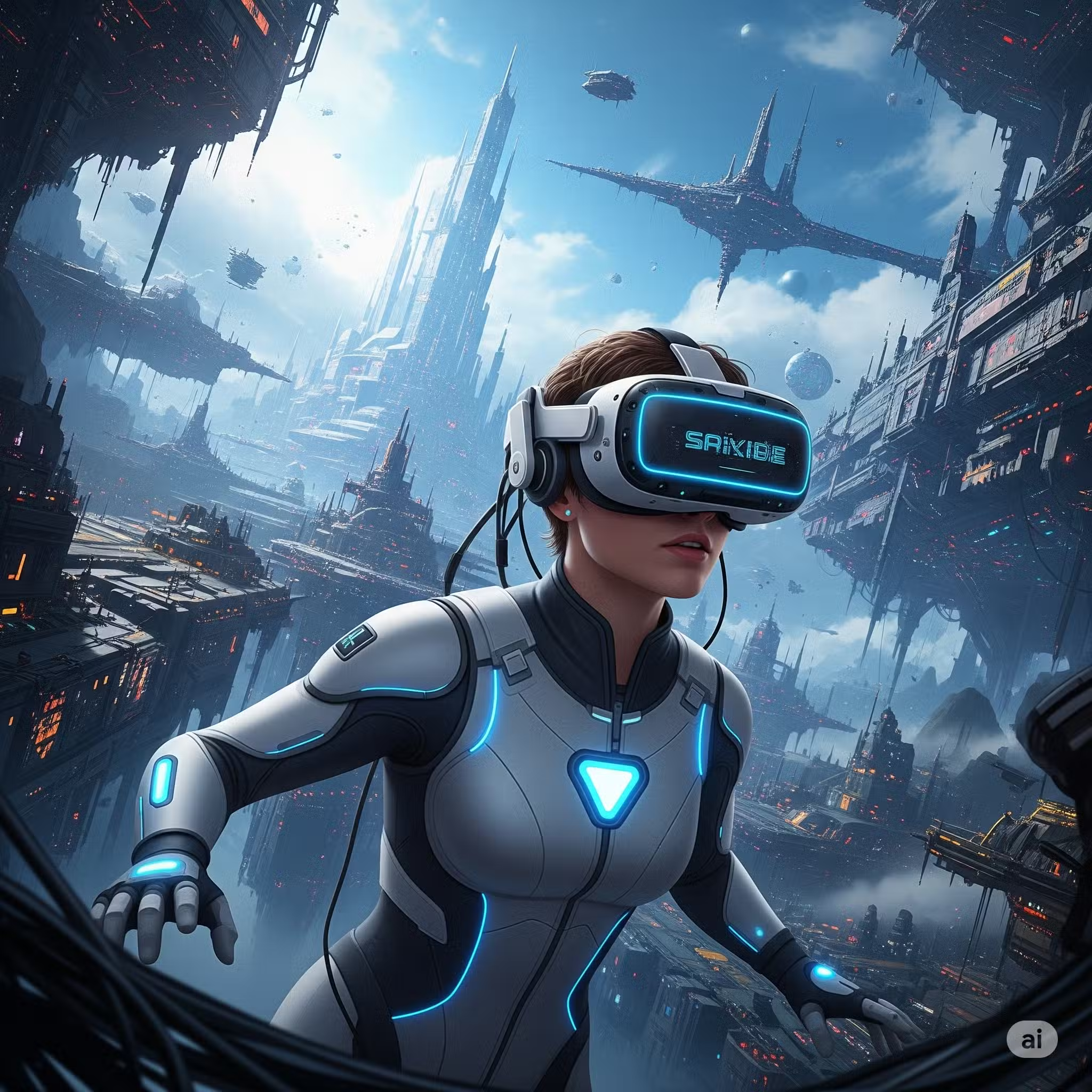
The Full Dive VR Vision
Full dive virtual reality, which allows for the complete immersion of consciousness in a digital world while the physical body remains at rest, has captivated our imagination for decades. From science fiction novels to anime series, this ultimate form of virtual reality represents the pinnacle of immersive technology.
The concept involves bypassing our physical senses entirely, sending signals directly to the brain to create completely convincing virtual experiences. Users would see, hear, feel, and even smell virtual environments as if they were real.
While this might sound like pure fantasy, recent advances in neurotechnology, brain-computer interfaces, and our understanding of neural pathways suggest that full dive VR isn’t just possible, it’s inevitable. The question isn’t whether we’ll achieve it, but when and how.
The implications extend far beyond gaming and entertainment. Full dive VR could revolutionize education, training, therapy, and human communication in ways we’re only beginning to imagine.
Current Technology Building Blocks
Brain-computer interfaces have made remarkable progress in recent years. Companies like Neuralink are developing systems that can read neural signals with unprecedented precision, while researchers have successfully demonstrated direct neural control of computer systems.
Haptic feedback technology is advancing rapidly, with systems now capable of simulating texture, temperature, and even pain sensations. While current haptic suits are bulky and limited, the underlying principles for full-body sensory simulation are being established.
Display technology is approaching the theoretical limits of human vision. Modern VR headsets are nearing retinal resolution, and emerging technologies like direct retinal projection could eliminate displays entirely.
Processing power continues to grow exponentially, with specialized chips designed for neural processing and real-time world simulation. Cloud computing and edge processing are making previously impossible computational tasks routine.
Breakthrough Research and Development
Neural interface research is accelerating across multiple fronts. Scientists have successfully demonstrated direct visual input to the brain, bypassing the eyes entirely. Similar breakthroughs in auditory and tactile neural stimulation show that direct sensory input is technically feasible.
Universities worldwide are mapping neural pathways with increasing precision. The Human Connectome Project and similar initiatives are creating detailed maps of how our brains process sensory information, providing a roadmap for full-dive interfaces.
Machine learning is revolutionizing our ability to interpret and generate neural signals. AI systems can now decode intended movements from brain activity and are beginning to understand more complex neural patterns related to perception and consciousness.
Recent advances in non-invasive brain stimulation suggest that full dive VR might not require surgical implants. Techniques such as focused ultrasound and advanced magnetic stimulation could achieve the necessary neural precision without the need for invasive procedures.
Technical Challenges and Solutions
Safety remains the paramount concern for any direct neural interface. However, researchers are developing sophisticated safety protocols and fail-safes that could make full dive VR as safe as current medical procedures.
The bandwidth required for the transmission of complete sensory data is enormous. Still, advances in neural compression and selective stimulation suggest that complete sensory immersion might require far less data than initially anticipated.
Power consumption and miniaturization challenges are being addressed through advances in neuromorphic computing and ultra-low-power neural interfaces. Future systems can operate on power levels comparable to those of current mobile devices.
Individual neural pattern variations present a significant challenge, but machine learning systems are becoming increasingly adept at adapting to individual neural signatures. Personal calibration systems could learn and adapt to each user’s unique neural patterns.
The Path Forward and Business Implications
Conservative estimates suggest that basic full dive VR could emerge within the next 15-20 years, with more sophisticated systems following in the decades after. This timeline depends on continued advances in neurotechnology and our willingness to embrace these transformative technologies.
The business implications are staggering. Industries, from education to healthcare, could be entirely transformed by technology that allows for the perfect simulation of any experience or environment.
At Seisan, we’re actively preparing for this future by developing cutting-edge VR applications that push the boundaries of what’s currently possible. Our experience with advanced haptic integration, neural interface experimentation, and immersive world-building positions us at the forefront of this technological revolution.
While we continue to create exceptional VR experiences with today’s technology, we’re also investing in research and development that will enable the next generation of immersive experiences. The foundations we’re building today will support the full dive VR systems of tomorrow.
For a deeper dive into the current timeline and technological milestones, check out our post “How Close Are We to Full Dive VR?” which explores the specific developments bringing us closer to this revolutionary technology.
Ready to explore the cutting edge of VR development? Contact Seisan to discuss how we can help you create immersive experiences that push the boundaries of what’s possible today while preparing for the incredible possibilities of tomorrow.


