
The App That Almost Worked
A founder we know built an AI-powered app over the weekend. It connected to a CRM, auto-generated sales emails, pulled in data from three tools, and spit out pipeline reports in a slick dashboard.
It looked impressive. It even kind of worked.
But within two weeks, sales stopped using it, marketing no longer trusted the data, and operations asked whether it was safe to run. It wasn’t. The app was quietly shut down, and the company went back to Google Sheets.
What happened?
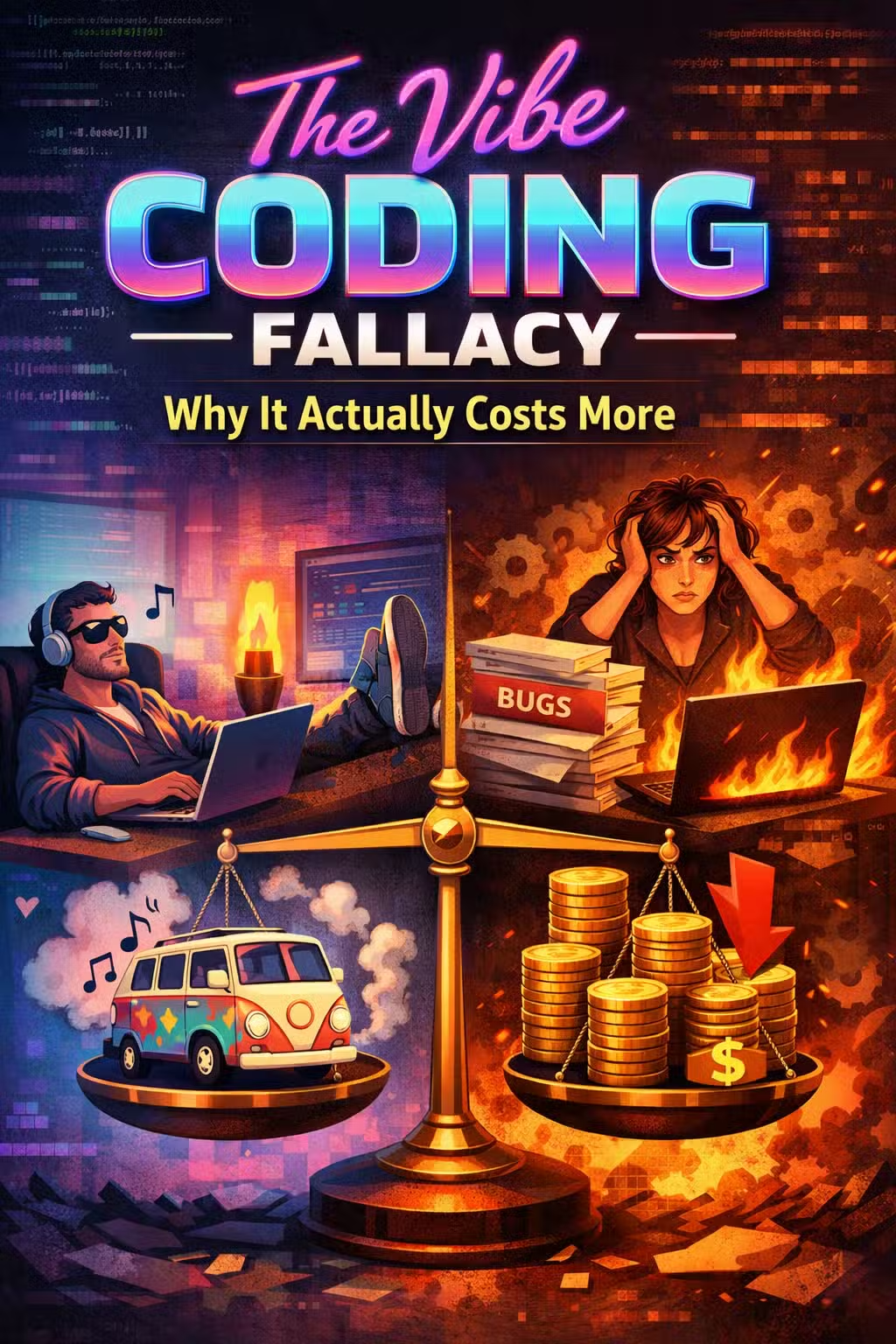
Vibe coding. A fast-growing movement fueled by low-code platforms, AI copilots, and public APIs, where people build software based more on dopamine than design. And while it feels like progress, it rarely delivers the durability or security businesses actually need.
At Seisan, we’ve been building scalable, secure software platforms for 20+ years, and we’ve seen this cycle before. Let’s break down how vibe coding works, why it’s so tempting, and why it often becomes a cost center disguised as productivity.

What People Mean by “Vibe Coding”
“Vibe coding” isn’t an official methodology; it’s a mindset. It usually looks like:
- A non-technical team member signs up for a low-code platform like Lovable, Bubble, or Make.com
- They connect a few APIs, write some prompts, and “ship” something fast
- A prototype appears overnight, but without specs, testing, or long-term thinking
It’s software without a blueprint. Code without context. Apps built to impress, not to last.
In other words, it is an activity without architecture.
Vibe coding is often celebrated on social media, “Look what I built in 12 hours!”, but in real-world businesses, these builds break down under pressure.
How Vibe Coding Works (And Why It Breaks)
The Actual Process
Most vibe-coded tools are built with low-code or AI-assisted development tools. Common platforms include:
- Zapier / Make.com: For automation between apps
- Bubble / Glide: For visual web apps
- ChatGPT / Copilot: For AI-assisted scripting
- Retool: For internal tools with drag-and-drop dashboards
These platforms promise “no engineers needed.” But under the hood, someone still needs to understand:
- Architecture: How systems should be structured for scale, security, and change
- Data Models: What data lives where, how it flows, and who owns it
- Ownership: Who maintains this when the original builder moves on?
Vibe coding skips these questions. It works… until you ask it to work with the rest of your company.
Why It Feels Good To Use
Let’s be honest: vibe coding feels great. Here’s why:
- Instant Feedback Loop
- Low-code builders and AI tools are designed to deliver results right away. You see progress immediately, which feels like productivity, even if it’s just a surface-level output.
- Illusion of expertise
- You don’t need to know how OAuth tokens or database schemas work; you just need the right prompt or plugin. It feels like you’re building real software. And in some cases, you are. But it’s often software without guardrails.
- Use of AI vs Humans
- AI copilots like GitHub Copilot or ChatGPT speed up tasks, but they’re not decision-makers. They’ll generate solutions even when they don’t fully understand the problem.
- Activity vs Productivity
- Building something fast isn’t the same as building something useful. But vibe coding rewards the doing, not the outcome.
We’ve seen internal teams build entire quoting systems on top of ChatGPT and Google Sheets. It looked clever until legal and finance asked how pricing logic was enforced. It wasn’t.
Three Costs No One Talks About
1. Understanding Tasks
Teams can’t debug what they didn’t design. If you used AI to write 80% of your logic, what happens when it breaks? Or when someone else inherits it? Other departments often have no clue what the tool is doing.
2. Integration Tax
The app works…until you try to connect it to your CRM, ERP, or secure data warehouse. Suddenly you’re dealing with:
- Complex auth flows
- Custom data mapping
- Compliance issues (especially in healthcare or finance)
- Business rules AI doesn’t understand (yet)
3. Rewrite/Revamp Reality
Prompting your way to a full app sounds fast until you have to rebuild it properly. Most AI-assisted tools can’t express deep intent, logic, or data flows cleanly. You hit a wall and realize you now need to rebuild it from scratch with the right architecture this time.
External Links:
NIST Secure Software Development Framework
OWASP: Risks of AI-Generated Code

Where Vibe Coding Makes Sense
To be clear: we’re not anti-AI. Or even anti-low-code. But you have to use the tool for what it’s good at.
Here’s where vibe coding can shine:
- Marketing emails and campaign workflows
- Internal prototypes or proof-of-concepts
- Simple mobile apps built off scripts
- Slack/Teams bots to automate simple requests
These are lightweight, non-critical, and fast to discard or improve. Vibe coding is great for testing ideas, not powering core operations.
Organizational Debt From Vibe Coding
What starts as speed often turns into debt. Here’s how:
- Shadow IT grows
- Tools are built outside of IT’s visibility. No security reviews. No version control. No audit trails.
- Security risks multiply
- Public AI tools and APIs can expose sensitive data. Some teams unknowingly train public models on private data.
- Developers become janitors vs architects.
- When engineering does get involved, it’s to fix or rebuild someone else’s mess. Instead of designing scalable systems, they’re reverse-engineering spaghetti workflows.
The Right Way to Use AI In Development
At Seisan, we use AI every day, in the right places.
We use AI-assisted coding for boilerplate and testing. We apply LLMs for documentation parsing, summarizing meeting notes, or helping design workflows. We even integrate low-code platforms for specific, scoped use cases (e.g., internal dashboards, marketing reports).
But we pair AI with real architecture. Real data models. Real compliance reviews. And real humans who know when to trust the tool and when to write code from scratch.
AI helps accelerate the process. It’s not the process.
Learn how Seisan builds smarter software →
Explore our technology consulting services →

Tools Don’t Build Systems – People Do
AI is not a strategy. Low code isn’t a solution. And vibe coding? It’s not a development process; it’s a shortcut that too often leads to long-term costs.
The companies that win will be those that combine speed with structure. Innovation with architecture. AI with actual engineering.
That’s where Seisan comes in. We help companies move fast, but smart. We turn prototypes into platforms. Contact us today, we will make sure what gets built today still works tomorrow.


