
A few years ago, a leadership team we advised proudly announced they had become an “AI-driven organization.”
They had predictive dashboards, automated reporting, and a customer-facing chatbot.
On paper, they were digitally advanced.
Operationally, they were still blind.
Their systems could forecast demand, but could not account for shelf placement inside warehouses. Their analytics predicted service calls but ignored technician proximity and route congestion. Their AI processed data, but none of it understood physical context.
This is a pattern we see repeatedly when speaking with executive teams.
Businesses treat data as something that lives in dashboards and cloud platforms, forgetting that real operations happen somewhere; on job sites, inside manufacturing plants, across retail floors, within hospital campuses, and throughout distribution networks.
Spatial AI exists to close that gap.
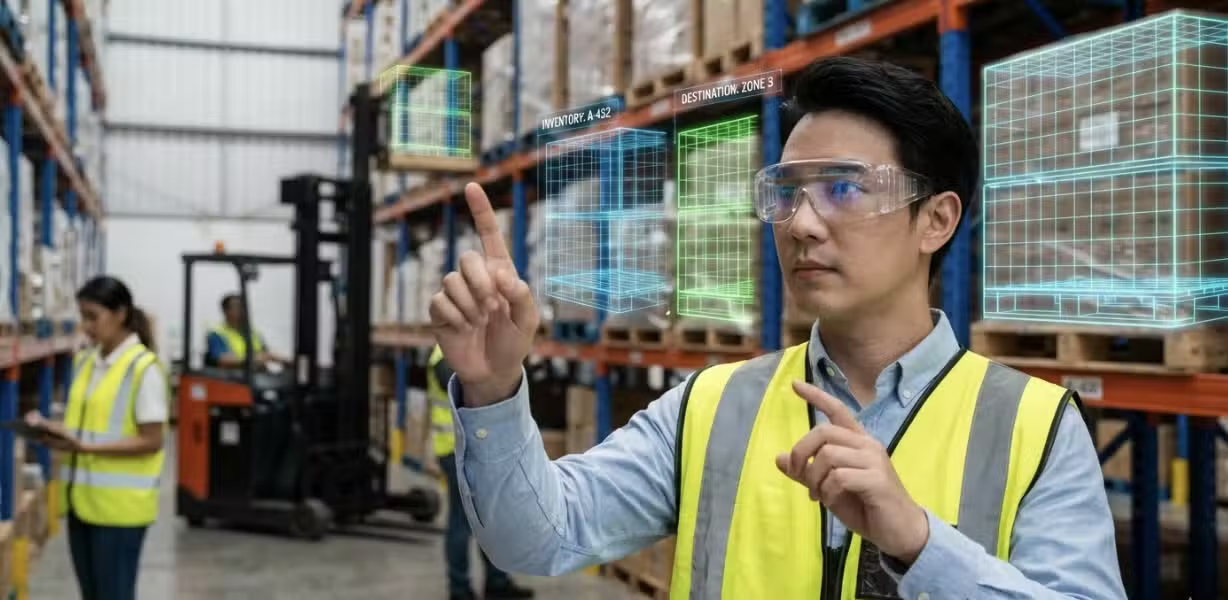
It gives digital intelligence the ability to perceive, interpret, and act within the physical environments your organization actually operates in.
What Exactly is Spatial AI?
Spatial AI is the capability that allows machines to understand space.
It enables systems to interpret distance, orientation, depth, movement, and environmental relationships — not just rows and columns of structured data.
If traditional AI is the analytical brain of your enterprise, Spatial AI is its visual and locational cortex.
It answers not only “what happened,” but “where did it happen, why there, and what does that mean operationally?”
This shift is accelerating because infrastructure has converged.
5G networks reduce latency.
LiDAR sensors are embedded in consumer and enterprise devices.
Computer vision models now interpret motion and depth with remarkable accuracy.
Edge computing enables real-time spatial processing.
What was experimental five years ago is commercially viable today.
The Hardware Layer – Giving AI Eyes and Depth
Spatial intelligence begins with capture.
Modern AI can generate high-fidelity 3D environments from simple photographs using photogrammetry and neural reconstruction. Warehouses, construction sites, retail stores, and industrial facilities can now be digitized without multimillion-dollar scanning systems.
Cameras have evolved from passive recording devices into active interpreters.
With computer vision running at the edge, they detect unsafe behavior, monitor proximity zones, measure dwell time, and analyze movement patterns in real time.
Next-generation mixed-reality hardware is accelerating adoption.
Devices such as Apple Vision Pro and advanced AR platforms are not novelty gadgets. They are spatial computing interfaces that allow users to interact with digital environments overlaid onto the physical world.
As these technologies mature, executives will not rely solely on static dashboards.
They will step inside operational data.
The Spatial Intelligence Roadmap
Building spatial capability requires strategy, not gadgets.
Successful organizations follow four foundational phases.
1. Data Capture
Spatial inputs are collected through cameras, LiDAR, GPS, and environmental sensors to create a living digital representation of physical space.
2. Processing
Raw spatial data is heavy and unstructured.
It must be cleaned, aligned, and contextualized using computer vision and geospatial frameworks.
3. Understanding
Systems begin recognizing objects, tracking movement, measuring distance, and identifying patterns.
4. Action
Spatial awareness becomes valuable when it informs operational decisions.
Routing improves. Safety incidents decline. Layout optimization becomes measurable rather than assumed.
Spatial intelligence turns physical operations into controllable systems.
At Seisan, this approach powered the Performance Golf initiative, transforming swing footage into a spatial coaching engine. Instead of simply recording video, the system interpreted body position and rotation to generate measurable performance insights.
That distinction (between storing data and understanding motion) defines Spatial AI.
Learn more about our geospatial expertise or explore the Performance Golf case study
Where Industries Benefit Most
Spatial AI is not industry-specific.
It is operationally transformative.
- Field Service & Operations
- Optimize routing and reduce travel time
- Overlay repair instructions in AR
- Improve safety compliance through spatial monitoring
- Improve first-time fix rates
- Enhance coordination in the field
- Manufacturing & Industrial
- Monitor equipment proximity and hazard zones dynamically
- Enable predictive maintenance with environmental context
- Reduce workplace incidents and downtime through spatial modeling
- Real Estate & Construction
- Create digital twins of properties
- Improve planning through immersive walkthroughs
- Track asset movement across large developments
- Retail
- Analyze physical flow to engineer conversion
- Optimize store layouts
- Measure engagement with spatial precision
- Events & Experiential Marketing
- Measure booth engagement spatially
- Optimize layout design
- Track movement patterns to improve ROI
- Healthcare
- Enable hyper-accurate indoor navigation
- Track equipment location
- Improve coordination across complex campuses
The common denominator is the “where” advantage.
When physical context integrates into digital systems, decision-making accelerates.
Common Pitfalls
Executives must avoid two predictable traps.
The first is building spatial tools that do not integrate with ERP, CRM, or analytics platforms.
If spatial intelligence does not flow into enterprise workflows, it becomes novelty rather than leverage.
The second is hardware obsession.
We have seen organizations over-invest in headsets while ignoring lighting variability, bandwidth limitations, and user workflow friction.
Spatial AI is not about devices.
It is about operational intelligence.
For governance guidance, see the NIST AI Risk Management Framework.
Measuring Executive Impact
Technology alone does not earn executive attention.
Measurable advantage does.
Spatial AI should be evaluated through operational efficiency, risk reduction, revenue lift, and decision velocity.
In field operations, improved routing reduces travel time, fuel costs, and idle labor.
Even modest efficiency gains compound significantly across fleets and service teams.
In industrial environments, spatial monitoring reduces safety incidents and exposure to compliance risks.
Avoiding a single major incident can justify the entire investment.
In retail and experiential environments, spatial insight improves layout optimization and measurable engagement.
When you understand how customers physically move through space, conversion becomes engineered rather than assumed.
But the greatest impact is decision velocity.
Spatial context collapses the distance between insight and action.
Leaders move from reviewing abstract reports to interacting with live operational environments, testing scenarios before committing capital.
Frameworks such as the NIST AI Risk Management Framework underscore the importance of oversight and transparency in AI systems.
Standards from the Open Geospatial Consortium (OGC) ensure interoperability and architectural longevity.
The real executive question is not whether Spatial AI is innovative.
The question is whether your organization can afford to operate without physical awareness embedded in its digital strategy.
Spatial intelligence, when measured correctly, is not experimentation.
It is operational leverage.
The Digital Twin as the New Operating System
Today, many organizations treat the Digital Twin as a visualization layer.
In reality, it is becoming the next operating system for complex enterprises.
As spatial capture becomes continuous and immersive hardware matures, static dashboards will feel outdated.
When location accuracy reaches the inch level, autonomous logistics becomes viable at scale. Warehouses dynamically route inventory, and facilities adjust workflows in real time.
Hyper-accurate indoor navigation solves what GPS never could.
Hospitals, campuses, and industrial environments gain centimeter-level awareness of assets and movement.
Lost equipment disappears.
Response times shrink.
Operational blind spots close.
This is where Spatial AI moves from monitoring to orchestration.
Just as mobile computing replaced desktop interfaces, spatial computing will replace static dashboards.
The Digital Twin will not be optional.
It will define how serious organizations operate.
Those building spatial foundations today are not experimenting.
They are preparing for the next competitive era.
Closing Perspective: Give AI the Ability to See
AI that cannot see is incomplete.
Digital intelligence without spatial awareness creates blind spots that competitors will exploit.
The intersection of digital and physical is where the next decade’s advantage will be built.
At Seisan, we help executive teams design spatial foundations that scale, integrate, and deliver measurable returns.
If you are evaluating Spatial AI, Digital Twin initiatives, or immersive enterprise systems, let’s have a strategic conversation.
The future interface of business is spatial.
Build it deliberately. Connect with our team today to get started.


