
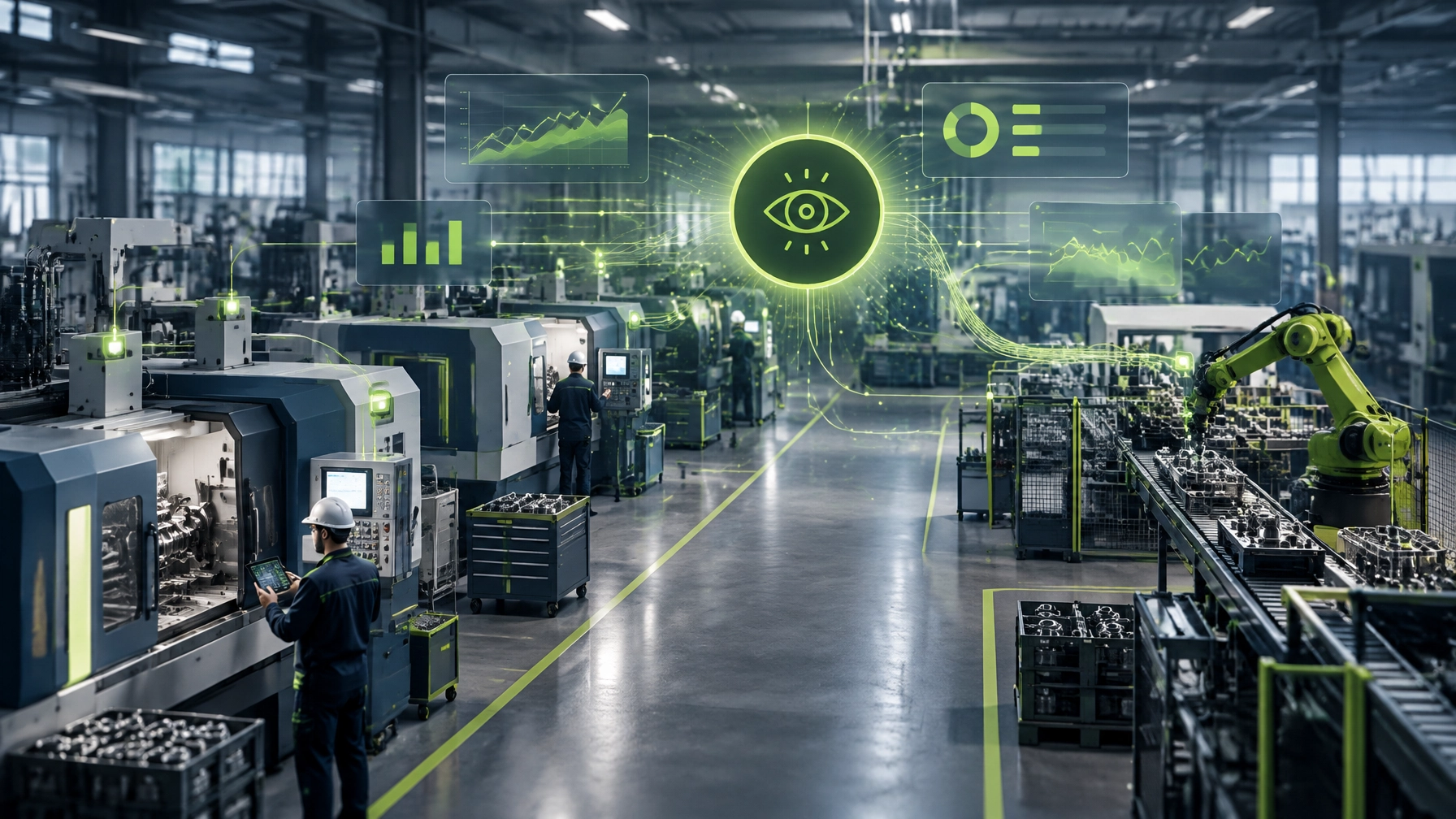
TL;DR: Shop floor visibility means seeing production status, throughput, quality flags, and downtime causes clearly enough to act while work is underway. Manufacturers can build that view by connecting useful machine and business-system data, agreeing on shared definitions, and starting with one operational workflow. A wholesale replacement of existing equipment or ERP is rarely the first step.
For many manufacturers, the information needed to manage production already exists, but in separate places. Machine readings stay in local systems, operators record progress on paper, and quality, output, and downtime information may take hours or days to reach a report.
When leaders rely on stale or manually reconciled data, they spend valuable time finding out what happened instead of deciding what to do next. Manufacturing operational visibility connects relevant information and makes the current state of work easier to understand.
Where does production data get stuck?
Production data often gets stuck at the handoffs between equipment, people, and systems. A machine may expose status through a local HMI or control system, while an operator records a job update on a paper traveler. A shift lead may transfer those notes to a spreadsheet, and a planner may later compare them with order information in the ERP.
Each step can add delay or ambiguity. Equipment names may not match across systems. A downtime event may have no reason code. A quality hold may be recorded separately from the work order it affects. Managers then have to ask which source is current, and whether the numbers mean the same thing.

This is not an unusual challenge. In its 2024 Data Mastery survey, the Manufacturing Leadership Council reported that 53% of respondents identified coordinating data from different systems as their leading data challenge. That finding describes the survey’s respondents, not every manufacturer, but it underscores how often disconnected information impedes operations. (Manufacturing Leadership Council, Data Mastery)
The practical result is familiar: a production issue becomes visible in a report only after the best opportunity to respond has passed. Connecting sources and reducing manual reconciliation gives teams more time to resolve exceptions.
What does real-time visibility on the shop floor look like?
A useful shop-floor view puts the information needed for a decision in one place, with enough context to trust it. Depending on the operation, that view may include:
- Line and work-order status: what is running, waiting, blocked, or complete.
- Throughput: actual progress compared with the schedule or target.
- Quality flags: holds, defects, rework, and inspection status tied to the relevant job.
- Downtime causes: when a line stopped, how long it was down, and the recorded reason.
- Data freshness: when information last updated, so users can distinguish current status from delayed information.

“Real time” should describe a decision-ready view, not a promise that every signal updates instantaneously. An alert for a safety or equipment condition may need near-immediate updates. A daily production summary may not. The right refresh rate depends on the decision, the source systems, and how quickly someone can respond.
The same discipline applies to OEE, or overall equipment effectiveness. NIST describes OEE as a combination of availability, performance, and quality. To make that measure useful, teams need consistent rules for planned production time, downtime, expected speed, and acceptable product. A dashboard without shared definitions can make conflicting numbers easier to see without making them easier to act on. (NIST, Recommendations for Collecting, Curating, and Re-Using Manufacturing Data)
A strong shop floor visibility solution therefore does more than display metrics. It connects data to the work, identifies exceptions, and helps route them to the right person. That turns status into a practical next step.
Do we need to replace our machines or ERP?
Usually not. Manufacturers can often improve visibility by connecting the systems they already rely on, then adding a targeted integration or workflow where a gap remains. The first task is to understand what data is available, who owns it, and which operational decision it needs to support.
Depending on the environment, relevant sources may include PLCs, HMIs, SCADA or MES platforms, quality and maintenance tools, historians, spreadsheets, and ERP systems. Not every source needs to connect at once. A focused first project might link one line’s status to a work order, or bring quality holds and production progress into a shared view.

NIST recommends starting with a defined use case and evaluating devices, available data, and network infrastructure before integration. It also emphasizes that collected data needs context and a plan for reliability, security, performance, and maintainability. (NIST manufacturing data collection guidance)
That is why machine data integration is not just a matter of connecting cables or sending raw tags to a dashboard. Equipment identity, timestamps, units, event meanings, and production context all affect whether teams can use the data reliably.
At Seisan, we help manufacturers connect systems, cut manual work, and create a clearer operational view without assuming that existing tools must be discarded. Our manufacturing solutions focus on improving the flow of information across production, quality, maintenance, and office teams. The benefit is a path to better visibility that fits the operation instead of disrupting it unnecessarily.
How should we start improving manufacturing operational visibility?
Start with one recurring decision that takes too long because information is scattered. For example: Which line is behind schedule, and what is blocking it? Then trace the information needed to answer that question:
- Name the decision and its owner. Identify who needs the information and what action they can take.
- Map the workflow and data sources. Follow the process across operators, equipment, quality, maintenance, and planning.
- Agree on definitions. Clarify what “running,” “down,” “complete,” or “on hold” means, and how those states are recorded.
- Connect and validate a focused set of data. Compare the new view with the records and observations teams already trust.
- Review how the view changes the work. Measure relevant outcomes, such as reporting effort, exception-resolution time, or handoffs, not dashboard logins alone.
A phased approach keeps the work grounded. It also exposes data-quality and ownership questions early, before a larger investment depends on assumptions.
Seisan’s operational visibility approach starts with the decision: who needs to know what, how quickly, and what should happen next? We then trace the sources, align definitions, and build a view around the workflow.
What can manufacturers learn from centralizing complex operational data?
The Orion Constellation case study shows how a company can bring complex operational information into a more usable view without treating data centralization as a simple reporting task. Seisan built an internal management and sales intelligence portal connected to Orion’s customized NetSuite environment. The solution consolidated data, including sales and work orders that supported custom chemical mix formulations, into role-based dashboards and reporting.
Orion’s project is not a machine-monitoring deployment, and it should not be mistaken for one. Its relevance is the underlying approach: preserve business meaning while connecting complex, customized data so teams can use it more effectively. That same principle matters on a shop floor, where a machine event only becomes useful when people can relate it to the job, quality status, schedule, and next action.
For a different example of modernizing a manual workflow, Seisan’s Railworks case study describes an offline-capable mobile application for field inspections. It illustrates how a digital workflow can support work where connectivity and existing processes shape the solution. In manufacturing, the same practical mindset helps teams build around real operating conditions instead of forcing a one-size-fits-all system.
Where can AI and automation fit?
AI and intelligent automation can help once the underlying information is accessible, relevant, and governed. For example, an organization may explore anomaly detection, automated summaries, or routing an exception for review. But those capabilities depend on clear source data, agreed definitions, and appropriate controls.
A visibility project can help establish that foundation. It connects the systems and organizes the information first; a later automation effort can then address a specific task with defined human review and accountability. Our AI and Intelligent Automation solutions start with the job to be done and the readiness of the data, not with a technology choice in search of a problem.
Manufacturers that improve visibility now give teams a stronger basis for daily decisions and future automation. Waiting leaves routine decisions dependent on scattered records and delayed reports.
Frequently asked questions about shop floor visibility
What is shop floor visibility?
Shop floor visibility is a clear, timely view of production activity and exceptions. It can bring together line status, throughput, quality information, and downtime causes so teams can understand current work and decide what needs attention.
Does real-time production data require replacing our ERP?
No. Many visibility projects connect relevant information from existing equipment and business systems, then add targeted integration or software where needed. The right approach depends on the workflow, data availability, and system constraints.
What data should we connect first?
Start with the data needed for one important operational decision. That could include equipment status, work-order progress, quality holds, downtime reasons, or maintenance records. Prioritize sources that help a team act, not every available signal.
How does shop floor visibility support OEE?
A visibility solution can help organize the equipment events and production context used to understand availability, performance, and quality. OEE becomes more useful when calculation rules and data definitions are consistent and transparent.
How do we begin?
Bring one workflow that regularly requires calls, spreadsheet reconciliation, or delayed reporting. In a working session with Seisan, we can discuss where the information gets stuck, which systems are involved, and whether a focused assessment makes sense. You do not need a technical plan to start, just one workflow in mind.