

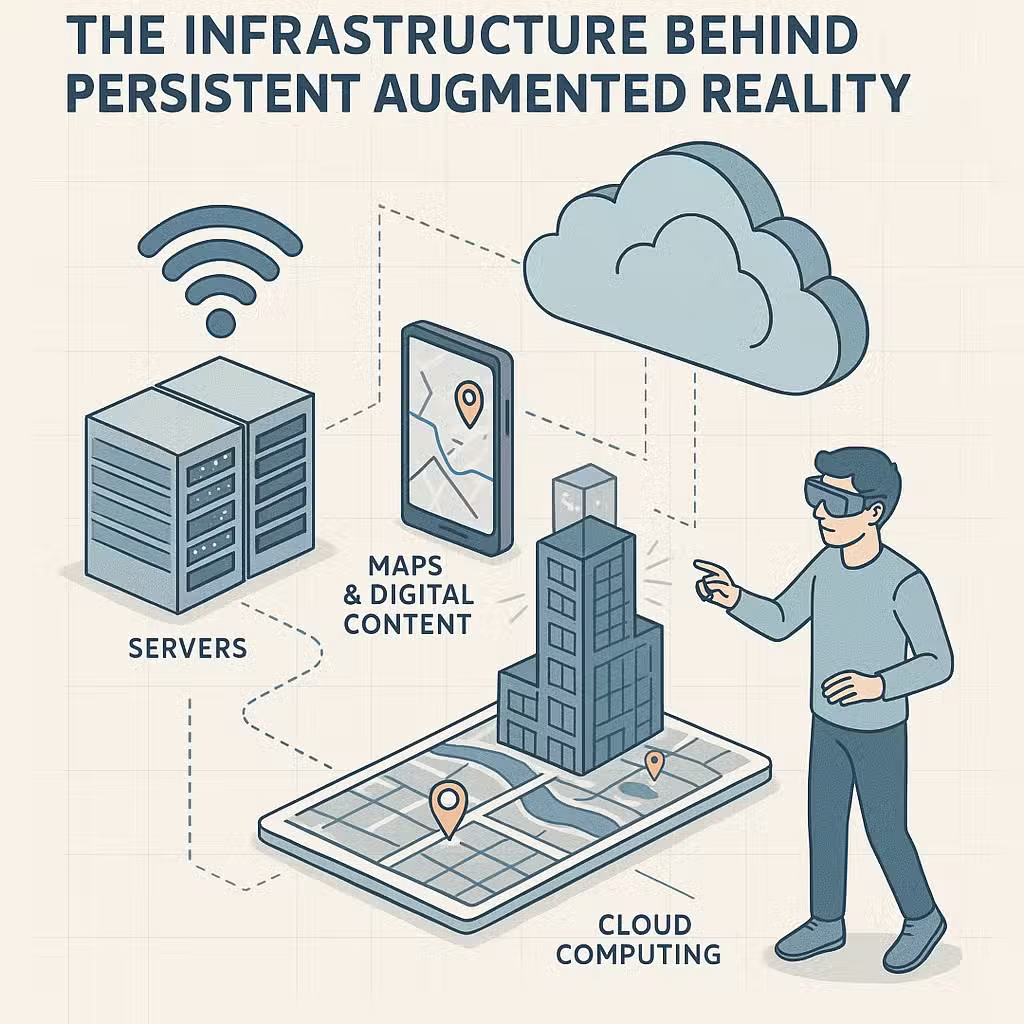
Understanding Persistent AR
Persistent augmented reality represents the holy grail of AR technology, digital content that remains anchored in specific real-world locations, visible to anyone who visits that space with an AR device. Unlike current AR experiences that disappear when you close an app, persistent AR creates a shared digital layer over our physical world.
Today’s AR experiences are largely isolated and temporary. When you use an AR app to visualize furniture in your living room, that virtual couch exists only during your session and only on your device. Persistent AR changes this fundamental limitation.
Imagine walking into a museum where digital information naturally appears next to exhibits, or entering a factory where maintenance instructions are permanently overlaid on machinery, visible to any worker with AR glasses. This isn’t science fiction; it’s the inevitable evolution of augmented reality.
The infrastructure required to make this vision a reality is complex, involving everything from 5G networks to massive cloud computing systems. Understanding these requirements helps explain why persistent AR is still emerging despite years of development.
Core Technical Components
Cloud-based spatial mapping forms the backbone of persistent AR. Unlike device-based mapping that creates temporary local maps, persistent AR requires detailed 3D maps of the physical world stored in the cloud and continuously updated as environments change.
Edge computing becomes crucial for delivering responsive experiences. When digital content needs to appear instantly as you look around, there’s no time for data to travel to distant servers. Local processing nodes reduce latency to imperceptible levels.
5G networks provide the bandwidth and low latency necessary for real-time AR experiences. Previous wireless technologies simply couldn’t handle the data requirements for detailed 3D environments synchronized across multiple users.
Cross-device synchronization ensures that everyone sees the duplicate digital content in the exact locations. This requires sophisticated systems that account for the different device capabilities, viewing angles, and positioning accuracy.
The AR Cloud: Foundation of Shared Reality
The AR Cloud is a real-time 3D copy of the physical world, complete with digital annotations and objects. It’s built through continuous scanning and mapping by millions of devices, creating an ever-updating model of our environment.
This shared digital layer enables collaborative experiences that feel natural and intuitive. Multiple users can interact with the same virtual objects, leave persistent messages for others, or collaborate on projects that span both physical and digital elements.
Data consistency across platforms presents enormous technical challenges. When someone using an iPhone places a virtual object, users on Android devices or AR glasses must see it in the exact location with identical properties.
Privacy considerations become complex when digital content is tied to physical locations. Who controls what appears in public spaces? How do we prevent digital vandalism while enabling creative expression?
Current Challenges and Solutions
The scale of data required for persistent AR is staggering. Detailed 3D maps of entire cities, updated in real-time, need storage and processing capabilities that push current technology to its limits. Cloud providers are developing specialized infrastructure to handle these requirements.
Latency remains a critical challenge. Even milliseconds of delay can break the illusion that digital objects belong in the physical world. New compression algorithms and predictive rendering techniques are addressing these timing requirements.
Device standardization is essential for widespread adoption. Currently, AR experiences often work only on specific platforms or devices. Industry standards for spatial mapping and content sharing are still evolving.
Energy consumption affects both devices and infrastructure. Continuous 3D mapping and real-time rendering drain batteries quickly, while cloud infrastructure requires enormous computing resources to serve global persistent AR experiences.
Building the Persistent AR Future
The timeline for widespread persistent AR adoption depends on several converging technologies. We’re likely 3-5 years away from basic persistent AR in controlled environments, with broader deployment following as infrastructure scales.
Business opportunities are emerging across industries. Retail, real estate, education, and entertainment are already exploring persistent AR applications, while new business models centered on digital content and spatial advertising are emerging.
Organizations that understand these infrastructure requirements can position themselves advantageously. The companies building persistent AR experiences today are developing expertise that will become incredibly valuable as the technology matures.
At Seisan, we’re actively working with the emerging technologies that will enable persistent AR. Our development approach considers both current capabilities and future infrastructure possibilities, ensuring that today’s AR experiences can evolve into tomorrow’s persistent applications.
We’re exploring advanced spatial mapping techniques, cloud-based rendering systems, and cross-platform compatibility solutions that will form the foundation of persistent AR experiences. This research directly benefits our current clients while preparing for the persistent AR future.
Ready to explore how persistent AR could transform your business? Contact our team to discuss how we can help you develop AR experiences that are ready for the persistent future.


